MoreExam
1. Question Content...
EXPLANATION
Answer: X - EXPLANATION Content.
Question1: Refer to the exhibit.A network engineer assigns a VLAN pool with hash mode to a virtual-ap profile. The VLAN pool (includes VLAN 50 and VLAN 60 for Corp SSID, server will send Aruba-User-VLAN attribute-70, just for USERR2.The first time a user logs in to a public laptop as an employee the user is assign.If the next user logs in to the same laptop as USER2, which VLAN does the user get?
Question2: A company network consists of a mix of Aruba wireless products and a few other vendors's AP. The network administrator thinks the problem is caused by an Aruba WIDS setting.What could be the cause of the issue?
Question3: A network engineer plans to deploy RAP. The company requires RAP to have redundancy so that it can failover to another controller if the primary controller fails.Which RAP configuration should the engineer implement to meet these requirements?
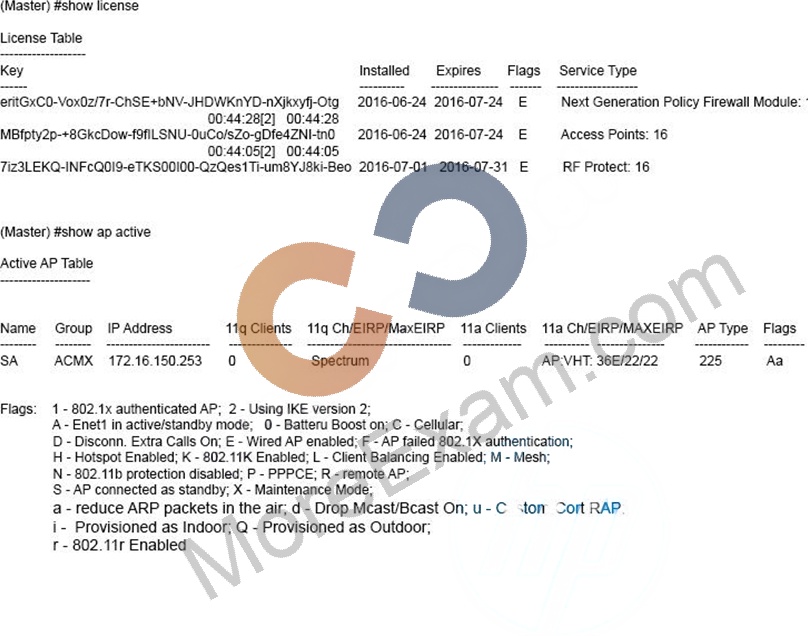
Question4: Refer to the exhibit.An end user attempts to connect to the company's campus network and cannot find the enterprise SSID even though there is an AP operating engineer attempts to resolve the end user's connectivity problem and issues the show ap active command on the controller shown in the exhibit.What are the possible reasons why the end user cannot find the enterprise SSID? (Choose two.)
Question5: A network administrator wants to use AirWare to monitor controllers and APs. Which information must the administrator have to configure AirWave? (Choose two.)
Question6: A network engineer troubleshoots a provisioned RAP backup SSID issue that occurs when a user tries to connect to the Internet from a hotel. The engineer lists the connection and sees backup SSID from an AP broadcast. The engineer can connect to it receives an IP address from the RAP's DHCP pool, but the captive portal of the hotel will not come up. The backup SSID is always there, and the enterprise SSID does not appear.What is a cause of this?
Question7: Refer to the exhibit.The network shown in the exhibits is configured with an active and standby controller that uses Layer 3 redundancy for AP termination. There are 100 APs provisioned into the AP Group NY1. The active local controller fails and the APs terminate on the standby local controller. Centralized licensing is enabled on the controller cluster with capacity for 100 APs. The WLAN clients are not able to SSID.What could be the source of the problem?
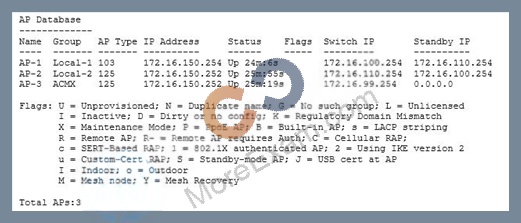
Question8: Refer to the exhibits on the tabs.Exhibit 1Exhibit 2Exhibit 3A network engineer configures AP termination with redundancy. The engineer executes the show ap database command on a master controller. The output is shown in the exhibit.What can the engineer determine from this output?
Question9: An Aruba 7205 controller functions as a standby master. How many Campus APs can it control while in standby mode?
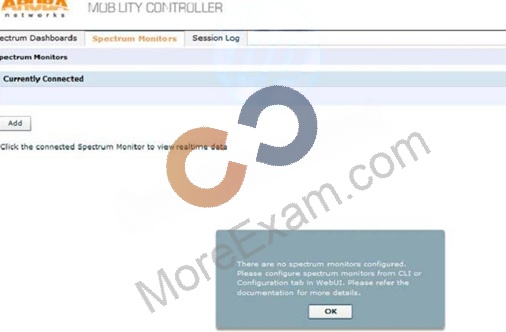
Question10: Refer to the exhibits on the tabs.Exhibit 1Exhibit 2A network engineer needs to deploy a Spectrum Analyzer (SA) and then monitor the 2.4Ghz and 5Ghz spectrum. As per the requirement, the engineer is able to convent some APs into SA temporarily, but when the engineer monitors the spectrum through the controller there are issues.Based on the information shown in the exhibits, what is the issue?
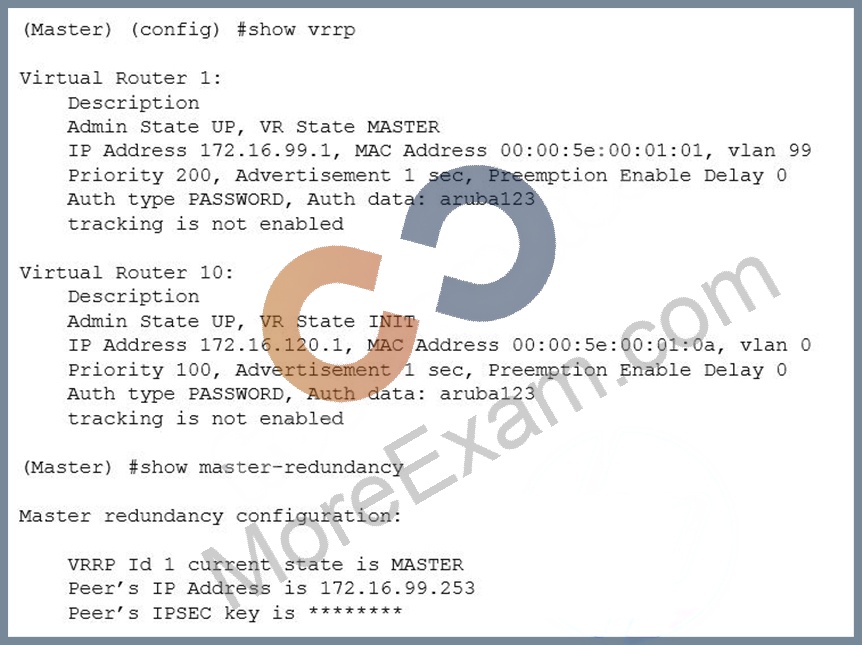
Question11: Refer to the exhibit.A network has one master and two local controllers with 200 APs that provide an employee WLAN. The Master controller is configured with two AP groups, North and South. The Local 1 and Local 2 controllers are located in the data center and are configured with VRRP instances. The customer would like to utilize both controllers for active-active local controller redundancy.How should the network administrator configure the controller VRRP instances in the AP groups for active- active controller redundancy?
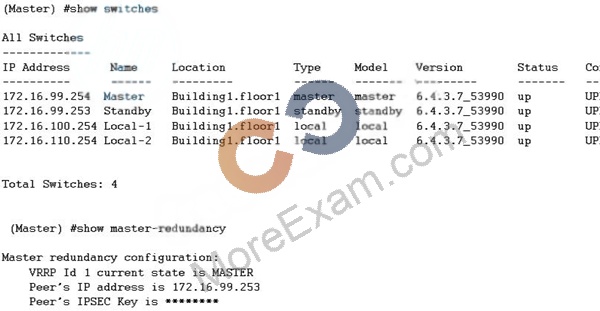
Question12: Refer to the exhibits on the tabs.Exhibit 1Exhibit 2The exhibits display the output of "show" commands on the Master, local-1, and Local-2 controllers. Based on the output, what is true about client roaming?
Question13: A network engineer plans for a corporate WLAN that must support 802.1X authentication. Based on HA best practices, the engineer plans to deploy a 7210 controller as an active local controller and terminate100 CAPs in the primary data center. In a secondary data center, the engineer plans to deploy two 7030 controllers as standby local controllers and terminate 20 CAPs. The engineer notices that there is unstable and unpredictability transmission latency between the two sites.What should be the engineer do to configure this solution according to HA best practices?
Question14: Refer to the exhibit.The exhibit displays the rule configuration.A company uses an Aruba wireless network and decides to deploy AirWave to monitor and manage the network. A NOC engineer creates Rogue classification rules. All the APs are classified as Rogues.Based on the rule configuration shown in the exhibit, which classifying rule causes this unexpected behavior?
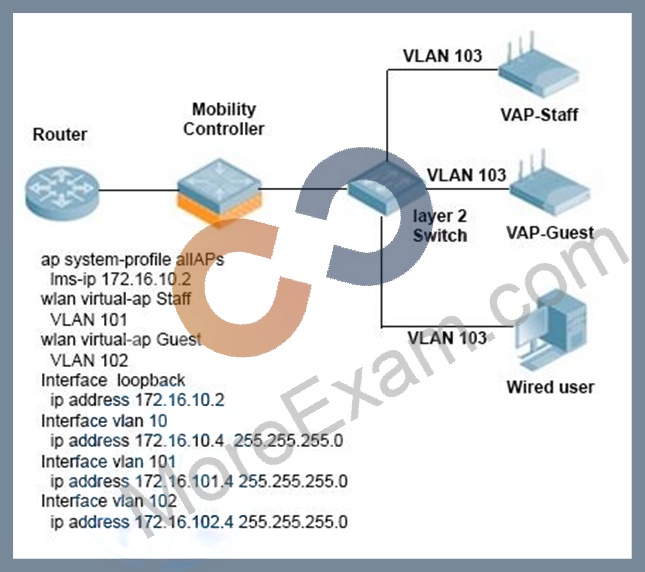
Question15: Refer to the exhibit.To support Guest SSID with tunnel-mode/Layer 3 deployment and Staff SSID with tunnel model/Layer 2 deployment, what must be configured on the trunk link between the router and the Aruba controller to meet the requirements?
Question16: Refer to the exhibit.Which VLAN will be mapped to the user connected to Employee SSID?
Question17: According to the client steering logic for sticky clients in the Aruba Client Match feature, what is true about the client movement to the new AP?
Question18: A network engineer plans to work on a guest provisioning account. The engineer wants to add the guest email and phone number fields in the account creation form.How can the engineer add these fields?
Question19: A network has one master controller and two local controllers. The local controllers are located in remote branch offices with a WAN link to the HQ site. The master controller is located at the HQ site. There are802.1X employee and captive portal guest SSIDs supported on APs in both the branch offices and HQ site.What must be allowed through a firewall located at the HQ site to ensure master and local controller communication?
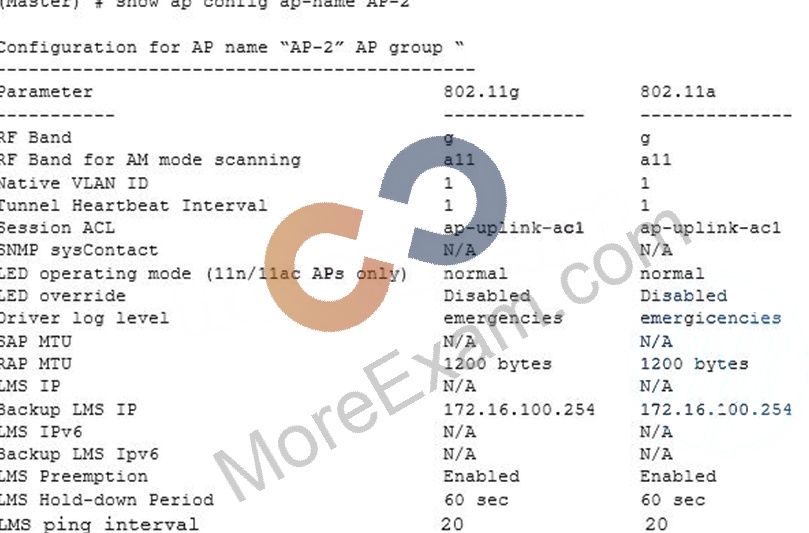
Question20: Refer to the exhibits on the tabs.Exhibit 1Exhibit 2A network engineer deploys an Aruba solution in a company. The network engineer tests the local controller failover and observes an issue. One of the local controllers (local-2_ does not failover to the standby controller when it loses communication with the master controller.
Question21: Refer to the exhibit.A network engineer configures AP termination redundancy as shown in the exhibit. Which type of redundancy is configured for the AP Groups on the controllers?
Question22: A network administrator in the IT department sets a new AP access security policy to enforce these requirements:All new Aruba APs that are in subnet 10.1.0/24 only can automatically join the Aruba master controllerin another subnet.The APs are automatically set to AM mode.All management traffic is protected in an encrypted tunnel.In subnet 10.1.0/24, there are also many Cisco APs that use the DHCP option to register with the Cisco WLC controller.Which steps should the network administrator take to implement the policy based on the requirements?(Choose two.)
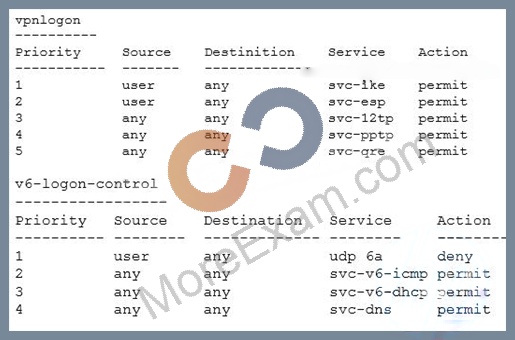
Question23: Review to the exhibits on the tabs.Exhibit 1Exhibit 2The exhibit shows truncated output from an Aruba controller. An unauthenticated user assigned to the logon role attempts to start n HTTP session to IP address 172.16.43.170. What happens?
Question24: Refer to the exhibit.Based on the configuration shown in the exhibit, what will happen with the AP?
Question25: Refer to the exhibit.Review the command outputs on the Master Controller6 shown in the Exhibits. All controllers in the cluster are Aruba 7220 controllers.What is the maximum number of APs that can terminate on Controller6?
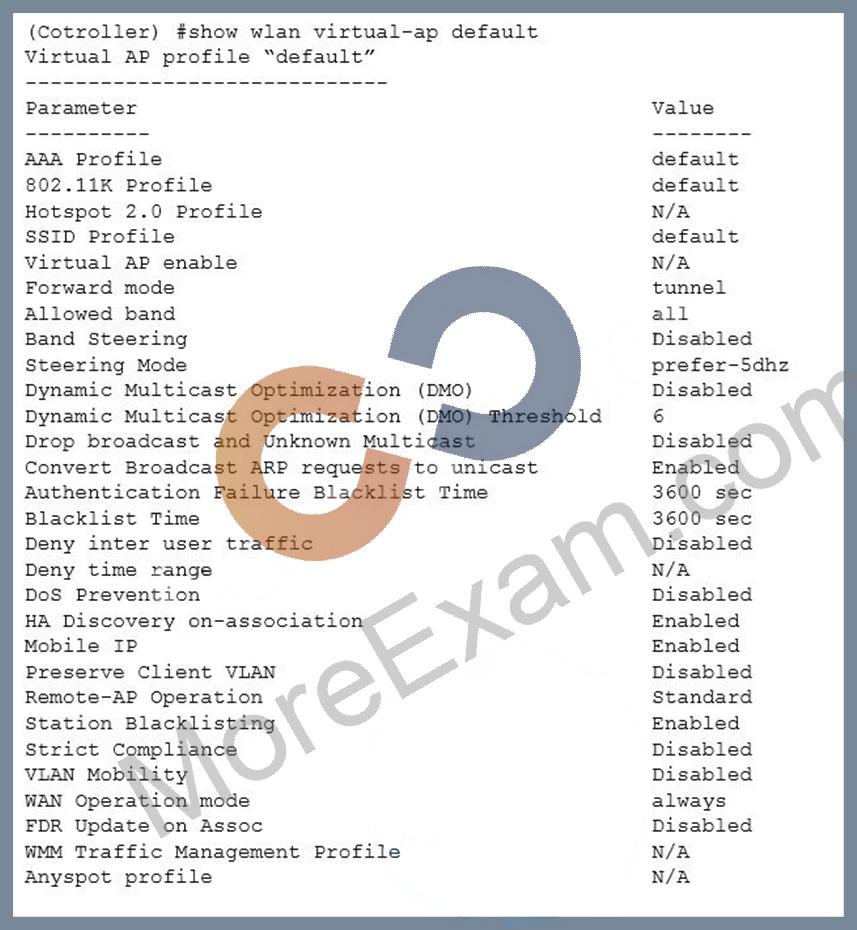
Question26: Refer to the exhibit.Based on the output shown in the exhibit, what is the roaming configuration for virtual-ap default?
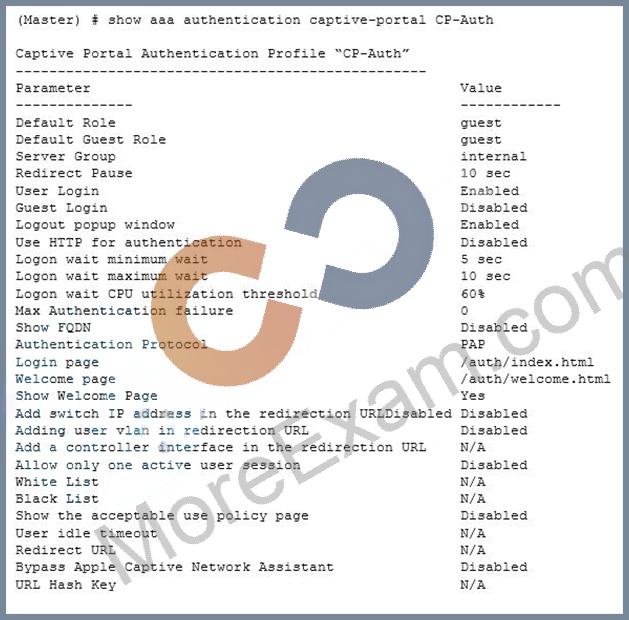
Question27: Refer to the exhibit.A network engineer configures a guest WLAN for username and password authentication. As per the company requirements, guests should be authenticated through the captive portal and should accept the terms and conditions. The engineer configures the guest WLAN for authentication, but the guest does not see the terms and conditions page.What is the issue?
Question28: How is AP redirected to a local controller after the DNS resolution returns the master controller IP address?
Question29: Refer to the exhibit.A network engineer needs to stop broadcasting an Employee SSID temporarily at the training Campus (AP-3 and AP-4) site. As per the company policy, the engineer cannot reprovision any APs and finds that all APs are provisioned with the same AP-group. The APs are broadcasting Employee, Admin and Guest SSIDs. The engineer consults with an Aruba expert to determine a solution for this.What should the Aruba expert recommend that the engineer do?
Question30: Refer to the exhibit.A network engineer needs a solution that allows employees at the remote office to access the Internet and other local resources, such as printers and storage. Employees should be able to access these resources even if the VPN connectivity between HQ and the Remote Office fails. As per the requirement, RAP should broadcast two SSIDs, CORP and LOCAL. The LOCAL SSID should not be visible to the employees as long as the VPN connectivity between Corporate HQ and the Remote Office is up.What is the recommended solution to meet the requirements?
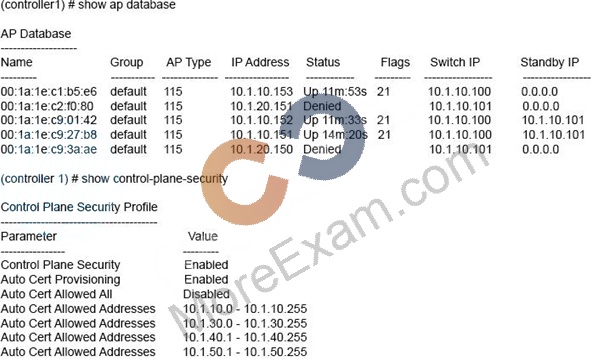
Question31: Refer to the exhibit.A network engineer adds two new AP 115s to an existing network. The status of the APs is denied in the controllers AP database.Based on the controller command output shown in the exhibit, what is the cause of the problem?
Question32: There are three controllers in a WLAN infrastructure one Master and two locals, Local-1 and Local-2. By default, which database will be used for guest captive portal authentication when the internal user database is selected?
Question33: An Aruba 7210 Controller AP-125s are added to AirWave. The controller is added in managed mode to the AirWave group named Aruba. After the controller is added, users start to experience problems and cannot connect to the WLAN.What could be the case of the problem?
Question34: Refer to the exhibits on the tabs.Exhibit 1Exhibit 2A company wants to deploy an Aruba solution with a master controller and a local controller along with 120 APs. The wireless clients in VLANs 55 and 20 are deployed in Layer 2 mode. The company has these requirements:The wireless clients should use the existing wired backbone to access DHCP, DNS, and authenticationservers.Controllers should be connected in a backbone switch that is configured to allow all VLANs.A network engineer designs and deploys the solution to meet the company requirements. During the testing phase, the engineer determines that wireless clients are not able to get the IP address from the DHCP server on the network backbone.Based on the output shown in the exhibit, what should the engineer do to solve the issue?